Courses
Below are the courses offered in Latino Studies. Check the requirements page for which courses count towards your program of study. Note that not all courses are offered every semester and course lists are subject to change.
To review current and recent course offerings, see the PATH class search link for ILS - Institute for Latino Studies. To enroll in the ILS Supplementary Major or Minor contact Dr. Karen Richman, Director of Undergraduate Studies, by emailing krichman@nd.edu or calling (574) 631-8146. We also encourage you to visit us at 315 Bond Hall.
Latino Studies Spring 2027 Courses
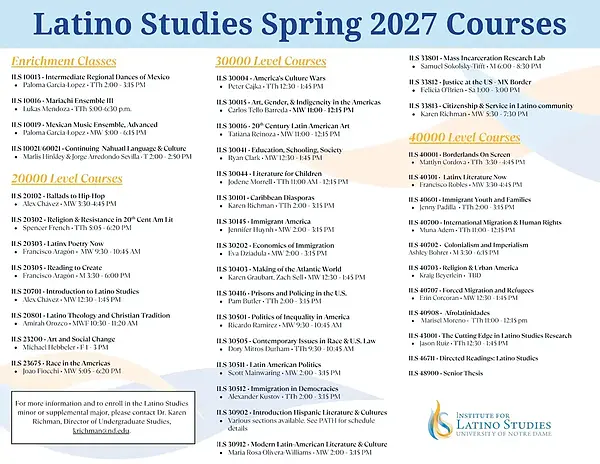
Enrichment Classes
-
ILS 10013, Intermediate Regional Dances of Mexico
Paloma Garcia-Lopez, TTh 2:00 PM to 3:15 PM (second half of semester) -
ILS 10016, Mariachi Ensemble III
Lukas Mendoza, TTh 5:00 PM to 6:30 PM (first half of semester) -
ILS 10019, Mexican Music Ensemble, Advanced
Paloma Garcia-Lopez, MW 5:00 to 6:15 PM (second half of semester) -
ILS 10021/60021, Continuing Nahuatl Language & Culture
Marlis Hinkley & Jorge Arredondo Sevilla, T 2:00 to 2:50 PM
20000 Level Courses
-
ILS 20101, Ballads to Hip-Hop
Alex Chávez, MW 3:30 to 4:45 PM -
ILS 20302, Religion & Resistance in 20th Century American Literature
Spencer French, TTh 5:05 to 6:20 PM -
ILS 20303, Latinx Poetry Now
Francisco Aragón, MW 9:30 to 10:45 AM -
ILS 20305, Reading to Create: A Writing Course
Francisco Aragón, M 3:30 to 6:00 PM -
ILS 20701, Introduction to Latino Studies
Alex Chávez, MW 12:30 to 1:45 PM -
ILS 20801, Latino Theology and Christian Tradition
Amirah Orozco, MWF 10:30 to 11:20 AM -
ILS 23200, Art and Social Change
Michael Hebbeler, F 1 -3 PM -
ILS 23675, Race in the Americas
Joao Fiocchi, MW 5:05 to 6:20 PM
30000 Level Courses
-
ILS 30004, America's Culture Wars
Peter Cajka, TTh 12:30 to 1:45 PM -
ILS 30015, Art, Gender, & Indigeneity in the Americas
Carlos Tello Barreda, MW 11:00 AM to 12:15 PM -
ILS 30016, 20th Century Latin American Art
Tatiana Reinoza, MW 11:00 AM to 12:15 PM
-
ILS 30041, Education, Schooling & Society
Ryan Clark, MW 12:30 to 1:45 PM -
ILS 30044, Literature for Children
Jodene Morrell, TTh 11:00 AM - 12:15 PM -
ILS 30101, Caribbean Diasporas
Karen Richman, TTh 2:00 to 3:15 PM -
ILS 30145, Immigrant America
Jennifer Huynh, MW 2:00 to 3:15 PM -
ILS 30202, Economics of Immigration
Eva Dziadula, MW 2:00 to 3:15 PM -
ILS 30403, Making of the Atlantic World
Karen Graubart, Zach Sell, MW 12:30 to 1:45 PM -
ILS 30416, Prisons and Policing in the U.S.
Pam Butler, TTh 2:00 to 3:15 PM -
ILS 30501, Politics of Inequality in America
Ricardo Ramirez, MW 9:30 to 10:45 AM -
ILS 30505, Contemporary Issues in Race & U.S. Law
Dory Mitros Durham, TTh 9:30 - 10:45 AM -
ILS 30511, Latin American Politics
Scott Mainwaring, MW 2:00 to 3:15 PM -
ILS 30512, Immigration in Democracies
Alexander Kustov, TTh 2:00 to 3:15 PM -
ILS 30902, Introduction Hispanic Literature & Cultures
Various sections available. See PATH for schedule details. -
ILS 30912, Modern Latin American Literature & Culture
Maria Rosa Olivera-Williams, MW 2:00 to 3:15 PM -
ILS 33801, Mass Incarceration Research Lab
Samuel Sokolsky-Tifft, M 6:00 to 8:30 PM -
ILS 33812, Justice at the US-MX Border
Felicia O'Brien, Sa 1:00 to 3:00 PM -
ILS 33813, Citizenship & Service in Latino Community
Karen Richman, MW 5:30 to 7:30 PM
40000 Level Courses
-
ILS 40601, Immigrant Youth and Families
Jenny Padilla, TTh 11:00 AM to 12:15 PM -
ILS 43504, Politics of Public Policy
Ricardo Ramírez, MW 11:00 AM to 12:15 PM -
ILS 46711, Directed Readings: Latino Studies
-
ILS 48900, Senior Thesis
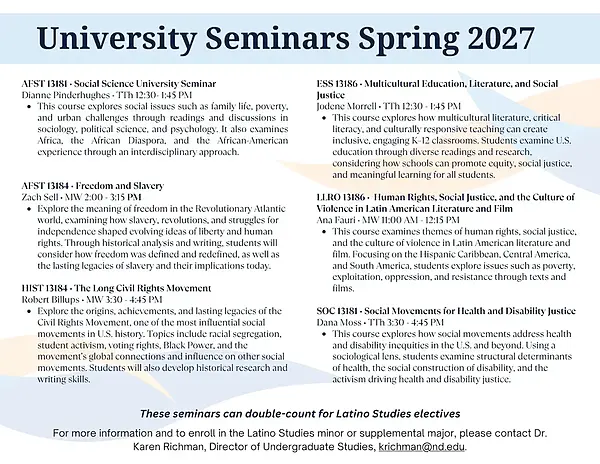
Latino Studies Spring 2027 University Seminars
-
ENGL 13186, On the Move: Migration in American Literature
Instructor: Francisco Robles
Time: TTh 3:30 PM to 4:45 PM
Description: This course explores the role of migration in twentieth-century U.S. literature and film. Students consider how movement shapes narratives, characters, and political ideas, and how migration redefines the American experience, homeland, and region. -
HIST 13184, Youth Activism and State Repression during the Sixties
Instructor: Jaime Pensado
Time: TTh 9:30 AM to 10:45 AM
Description: This course studies youth activism and state repression in the twentieth century, with a focus on the sixties in communities of color in the United States and Latin America. Students explore movements such as Black Power, Chicana/o activism, feminism, and counterculture, while also learning archival research through the history of student activism at Notre Dame. -
SOC 13181, How did I get here?
Instructor: Amy Langenkamp
Time: TTh 2:00 PM to 3:15 PM
Description: This course explores morality as a force that shapes social life, while also showing how moral principles are often challenged by competing personal, social, and political pressures. Students engage philosophical, psychological, and social-scientific perspectives alongside case studies of moments when morality was tested, reinterpreted, or distorted. -
SOC 13181, Contemporary Education Issues
Instructor: Mark Berends
Time: TTh 9:30 AM to 10:45 AM
Description: This course examines the relationship among society, schools, and teachers, with particular attention to educational opportunity and equity. Through research, media, discussion, and case studies, students analyze major debates in education and connect academic scholarship to real-world practice. -
POLS 13181, Race and Policing in the United States
Instructor: David Cortez
Time: TTh 12:30 PM to 1:45 PM
Description: This course explores the relationship between race and policing in the United States and asks whether policing as an institution can be reformed. Drawing on theory, history, empirical research, popular culture, and current events, students examine topics such as racial profiling, institutional reform, and the political effects of police contact. -
LLRO 13186, Human Rights, Social Justice & the Culture
Instructor: Tom Anderson
Time: TTh 11:00 AM to 12:15 PM
Description: This course examines themes of human rights, social justice, and the culture of violence in Latin American literature and film. Focusing on the Hispanic Caribbean, Central America, and South America, students explore issues such as poverty, exploitation, oppression, and resistance through texts and films.